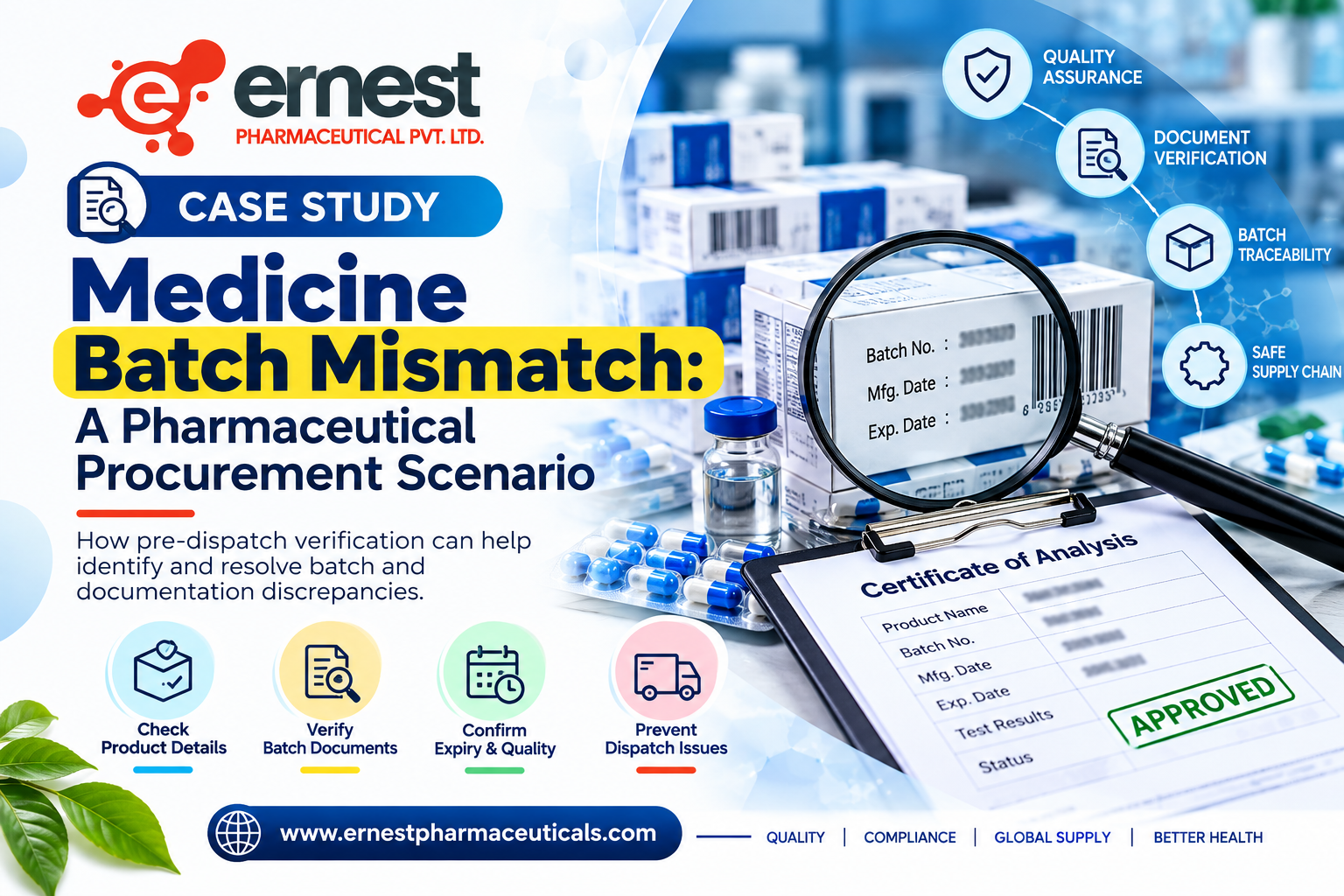
Medicine Batch Mismatch: A Pharmaceutical Procurement Case Study
Case Background
Pharmaceutical procurement involves more than confirming whether a medicine is available. Before a product moves toward dispatch, the medicine and its supporting documentation may need to be reviewed to ensure that important details are consistent.
One such detail is the batch number.
A batch number helps identify a particular manufacturing lot and connects the medicine with relevant manufacturing, testing, and traceability records. In this illustrative scenario, a medicine order had reached the pre-dispatch verification stage. The product name, strength, dosage form, and required quantity had already been reviewed. During the documentation check, however, an inconsistency was identified.
The Problem: Product and COA Show Different Batch Details
During the pre-dispatch review, the batch number printed on the medicine packs did not match the batch number stated on the available Certificate of Analysis (COA). This did not automatically establish that there was a problem with the quality of the medicine itself. The immediate concern was different: the batch-specific quality document available for review did not correspond to the stock selected for dispatch.
This raised an important procurement question:
Can a COA belonging to one manufacturing batch be relied upon as the batch-specific quality document for another batch?
When a COA is intended to represent a particular batch, the batch identification on the document should correspond to the relevant medicine batch. The discrepancy therefore needed to be investigated before the document could be relied upon for the selected stock.
Why Can a Batch Mismatch Occur?
A difference between the physical stock and available documentation can occur for several operational reasons. For example, a warehouse may hold more than one batch of the same medicine at the same time. New inventory may have arrived while documentation from an earlier batch remains in the product records. In another situation, documents may have been collected before the warehouse confirms which batch will ultimately be selected for dispatch. A document-selection or administrative error can also result in information from a different batch being attached to an order. The presence of a mismatch does not, by itself, explain its cause. For that reason, the appropriate response is to verify the information rather than make assumptions.
Step 1: Pause the Documentation Approval
Once the discrepancy is identified, the document review should not continue on the assumption that the available COA applies simply because the medicine name and strength are the same.
The first step is to confirm the actual batch intended for dispatch.
This is particularly useful before shipment because discrepancies identified at the pre-dispatch stage can generally be investigated before the goods enter the transport chain.
Step 2: Verify the Physical Medicine Stock
The actual stock selected for the order should be reviewed against the procurement requirement.
Depending on the product and applicable procedures, the verification may include:
- Medicine name
- Strength
- Dosage form
- Manufacturer
- Batch or lot number
- Manufacturing date
- Expiry date
- Pack configuration
- Quantity
- Packaging condition
The purpose of this check is to establish exactly which stock is being prepared for dispatch.
The verified information then provides the basis for reviewing the associated documents.
Step 3: Locate the Applicable Batch Documentation
After confirming the physical batch, the corresponding batch-specific documentation can be identified. For a Certificate of Analysis, relevant information may include the product identification, batch number, specifications, reported test results and the details of the issuing manufacturer or laboratory, as applicable. The objective is not simply to have a document titled “Certificate of Analysis.”
The document should be relevant to the medicine batch for which it is being used. This distinction is important in pharmaceutical procurement because document availability and document applicability are not necessarily the same thing.
Step 4: Check Connected Information
Finding one discrepancy provides a useful reason to review other related information. For example, once the correct batch is established, the procurement team may also verify whether the expiry information, product photographs, packing records and other batch-dependent details correspond to the selected stock.
This follows a useful procurement principle:
When one material inconsistency is identified, related information should also be reviewed rather than correcting only the visible error.
This can help prevent one corrected document from leaving another inconsistency unnoticed.
Step 5: Verify Remaining Shelf Life Separately
Correct batch documentation does not automatically mean that the medicine satisfies every procurement requirement. Remaining shelf life is a separate consideration. A newly confirmed batch may have a different manufacturing or expiry date from the stock initially expected. The procurement team should therefore verify whether the available remaining shelf life meets the buyer's agreed requirements. This is particularly important for bulk orders, where the medicine may remain in inventory for an extended period before distribution or use. A batch can have the correct documentation and still be unsuitable for a particular procurement requirement if its remaining shelf life does not meet the agreed specification.
Step 6: Resolve the Discrepancy Before Dispatch
Once the physical stock and documentation have been reviewed, the discrepancy can be addressed according to the applicable procurement and quality procedures. Several outcomes may be possible. If the appropriate batch-specific documentation is available and the stock meets the agreed requirements, the correct documents can be reviewed before the order proceeds. If the required documentation cannot be verified, the affected stock may require further assessment before dispatch. If another suitable batch is available, it may be evaluated separately according to the buyer's specifications. The appropriate action depends on the medicine, documentation requirements and applicable procedures. The important point is that the discrepancy should be resolved rather than overlooked simply to accelerate dispatch.
Outcome of the Illustrative Scenario
In this scenario, the inconsistency is detected during the pre-dispatch verification process.
The physical stock is checked, the applicable batch information is established and the supporting documentation is reviewed against the medicine selected for dispatch. The case demonstrates the purpose of a verification process.
The important outcome is not simply that an inconsistency was found. It is that the process provided an opportunity to identify and investigate it before the shipment progressed further through the supply chain.
No verification procedure can eliminate every procurement risk. However, systematic checks can help identify discrepancies while corrective action remains practical.
What Could Happen If a Batch Mismatch Is Missed?
If a batch discrepancy is not identified before dispatch, the receiving organization may discover that the batch-specific documentation does not correspond to the medicine delivered. This can create additional questions during goods receipt, quality review or document verification. The buyer may then need to request additional documentation or clarification after the shipment has already arrived or entered transit. For an international pharmaceutical shipment, resolving such questions after dispatch may be more complicated than addressing them during the preparation stage.
This is why pre-dispatch pharmaceutical verification can play an important role in procurement and supply-chain management.
Key Lessons From This Case Study
1. Physical stock should be verified
Documents collected earlier in the procurement process should not automatically be assumed to represent the batch ultimately selected for dispatch.
2. Batch-specific documents should correspond to the relevant batch
Where a document is intended to provide information about a specific manufacturing batch, its identifying details should be checked against the supplied stock.
3. Expiry verification remains important
Matching the correct batch and COA does not replace the need to review the remaining shelf life.
4. A discrepancy should trigger investigation
A mismatch does not automatically establish its cause. Verification should come before conclusions.
5. Pre-dispatch checks can identify problems earlier
Finding inconsistencies before shipment provides an opportunity to investigate them before the goods progress further through the supply chain.
Practical Pre-Dispatch Medicine Checklist
Before a pharmaceutical shipment proceeds, an appropriate verification process may include checking:
Product Identity: Is the correct medicine being supplied?
Strength & Dosage Form: Do they match the procurement requirement?
Manufacturer: Is the manufacturer consistent with the approved requirement, where applicable?
Batch Details: Does the physical product correspond to the batch-specific information being relied upon?
Expiry: Does the remaining shelf life meet the agreed requirement?
Quantity: Does the prepared quantity correspond to the approved order?
Packaging: Is the product packaging suitable and consistent with the requirement?
Documentation: Are the required documents relevant, complete and internally consistent?
Storage & Transportation: Are the required handling conditions understood and appropriately planned?
The exact checks required will vary according to the product, transaction, destination market and applicable regulatory requirements.
Frequently Asked Questions
1. What is a pharmaceutical batch number?
A batch or lot number is an identifier assigned to a defined quantity of pharmaceutical product manufactured under specified conditions. It supports product identification and traceability.
2. What is a batch mismatch?
A batch mismatch occurs when batch-specific information or documentation does not correspond to the batch of medicine being reviewed or supplied.
3. Does a batch mismatch mean that the medicine is counterfeit?
No. A batch mismatch alone does not establish that a medicine is counterfeit. It may result from inventory, administrative or document-selection issues. The discrepancy should be investigated to determine its cause.
4. Should a COA correspond to the medicine batch?
When a Certificate of Analysis is being relied upon as the batch-specific quality document for a medicine, its batch identification should correspond to the relevant batch.
5. Why should expiry be checked after batch verification?
Different batches can have different manufacturing and expiry dates. Therefore, identifying the correct batch does not automatically establish that the stock meets the buyer's remaining shelf-life requirement.
6. When should medicine batch details be verified?
Verification can occur at several stages of procurement. A pre-dispatch review is particularly useful for confirming that the stock prepared for shipment corresponds to the applicable information and documentation.
7. What should be done when a batch discrepancy is identified?
The discrepancy should be investigated according to applicable procurement and quality procedures. Relevant information should be verified before the affected documentation is relied upon.