General Medicine
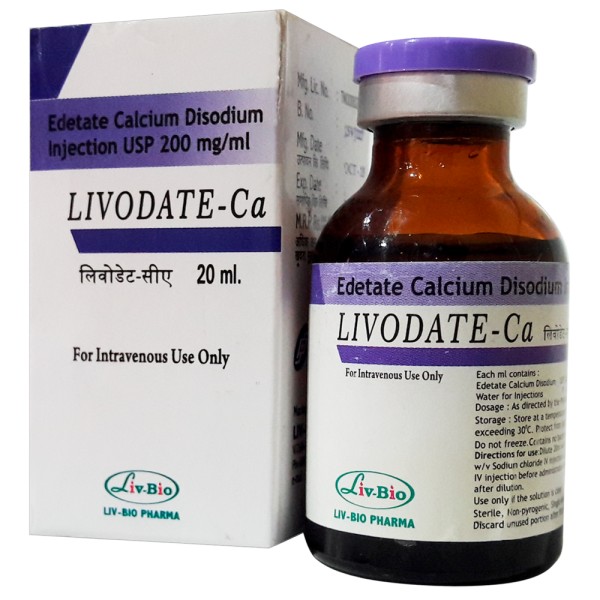
CALCIUM EDETATE INJECTION
Price on Request
Calcium Edetate Injection (also known as Calcium Disodium EDTA) is a chelating agent used mainly to treat heavy metal poisoning, particularly lead poisoning.
🔹 Primary Uses of Calcium Edetate Injection:
🧪 Lead Poisoning (Plumbism)
Main use: binds to lead in the bloodstream and helps eliminate it through the urine.
Often used in moderate to severe cases, especially in children and industrial exposure.
🌡️ Other Heavy Metal Toxicity (off-label or less common)
May also be used (less commonly) for:
Cadmium
Zinc (in overload situations)
Not used for mercury or arsenic—other chelators like dimercaprol or DMSA are preferred there.
🔄 Diagnostic Use (EDTA lead mobilization test)
Sometimes used to test the body's lead burden by observing how much lead is excreted after administration.
💉 How It Works:
Chelation therapy: The EDTA binds to heavy metal ions in the blood.
The resulting complex is water-soluble and excreted through the kidneys.
💉 Administration:
IV (intravenous) or IM (intramuscular) injection.
Usually given over several days, depending on lead levels and patient condition.
Often used alongside hydration therapy to protect the kidneys.
⚠️ Precautions & Side Effects:
Kidney function must be closely monitored — chelation can be hard on the kidneys.
Electrolyte imbalances (e.g., calcium, zinc depletion) may occur.
Possible side effects:
Fever, chills
Nausea, vomiting
Injection site pain
Low blood pressure (rare but serious)
❗ Important Notes:
Not the same as disodium EDTA, which is more toxic and not approved for lead poisoning.
Must be used under strict medical supervision, especially in children.
🔹 Primary Uses of Calcium Edetate Injection:
🧪 Lead Poisoning (Plumbism)
Main use: binds to lead in the bloodstream and helps eliminate it through the urine.
Often used in moderate to severe cases, especially in children and industrial exposure.
🌡️ Other Heavy Metal Toxicity (off-label or less common)
May also be used (less commonly) for:
Cadmium
Zinc (in overload situations)
Not used for mercury or arsenic—other chelators like dimercaprol or DMSA are preferred there.
🔄 Diagnostic Use (EDTA lead mobilization test)
Sometimes used to test the body's lead burden by observing how much lead is excreted after administration.
💉 How It Works:
Chelation therapy: The EDTA binds to heavy metal ions in the blood.
The resulting complex is water-soluble and excreted through the kidneys.
💉 Administration:
IV (intravenous) or IM (intramuscular) injection.
Usually given over several days, depending on lead levels and patient condition.
Often used alongside hydration therapy to protect the kidneys.
⚠️ Precautions & Side Effects:
Kidney function must be closely monitored — chelation can be hard on the kidneys.
Electrolyte imbalances (e.g., calcium, zinc depletion) may occur.
Possible side effects:
Fever, chills
Nausea, vomiting
Injection site pain
Low blood pressure (rare but serious)
❗ Important Notes:
Not the same as disodium EDTA, which is more toxic and not approved for lead poisoning.
Must be used under strict medical supervision, especially in children.
Enquire About This Product